
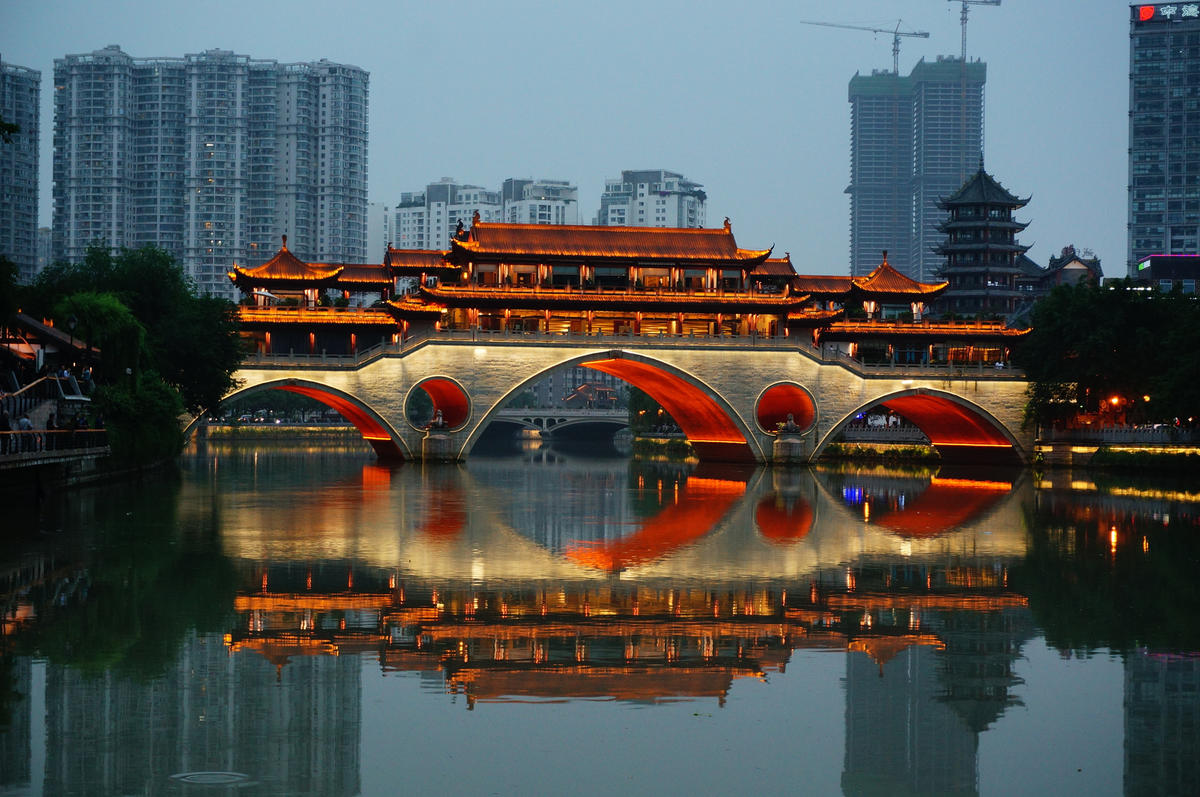
China — Travel Tips
Social Conventions
Cultural differences may create misunderstandings between local people and visitors. The Chinese do not usually volunteer information and the visitor is advised to ask questions. Hotels, train dining cars and restaurants often ask for criticisms and suggestions, which are considered seriously. Do not be offended if you are followed by a crowd; this is merely an open interest in visitors who are rare in the remoter provinces. The Chinese are generally reserved in manner, courtesy rather than familiarity being preferred.
The full title of the country is ‘The People's Republic of China', and this should be used in all formal communications. ‘China' can be used informally, but there should never be any implication that another China exists. Although handshaking may be sufficient, a visitor will frequently be greeted by applause as a sign of welcome. The customary response is to applaud back. Anger, if felt, is expected to be concealed and arguments in public may attract hostile attention.
In China, the family name is always mentioned first. It is customary to arrive a little early if invited out socially. When dining, guests should wait until their seat is allocated and not begin eating until indicated to do so. If using chopsticks, do not position them upright in your rice bowl as the gesture symbolises death. Toasting at a meal is very common, as is the custom of taking a treat when visiting someone's home, such as fruit, confectionery or a souvenir from a home country. If it is the home of friends or relatives, money may be left for the children.
If visiting a school or a factory, a gift from the visitor's home country, particularly something which would be unavailable in China (a text book if visiting a school, for example), would be much appreciated. Stamps are also very popular as gifts, as stamp-collecting is a popular hobby in China. A good gift for an official guide is a Western reference book on China.
Conservative casual wear is generally acceptable everywhere and revealing clothes should be avoided since they may cause offense. Visitors should avoid expressing political or religious opinions.
Photography: Places of historic and scenic interest may be photographed, but permission should be sought before photographing military installations, government buildings or other possibly sensitive subjects.
International Travel
Getting There By Air
The flag carrier is Air China (CA) (www.airchina.com.cn or www.air-china.co.uk).
Departure Tax
¥105, usually included in the airfare. Children under 12 and transit passengers (proceeding within 24 hours) are exempt.
Main Airports
Beijing Capital International (PEK/BJS) airport is 28km (18 miles) northeast of the city. To/from the airport: Buses and taxis area available (journey time - 40 minutes). An Airport Express subway line between the airport and central Beijing opened in 2008.
Guangzhou Baiyun International (CAN) airport is 12km (7 miles) north of Guangzhou (journey time - 25 minutes).
Shanghai Hongqiao (SHA) airport is 13km (8 miles) southwest of the city (journey time - 25 to 40 minutes). It is mainly served by domestic flights.
Shanghai Pudong (PVG) airport, in the eastern financial district, is 30km (19 miles) from the city center. To/from the airport: Buses and taxis are available (journey time - 50 minutes). Pudong is a major international airport with the Maglev magnetic levitation train and an underground link Metro line 2 connects Shanghai Pudong with Shanghai Hongqiao airport. The Maglev takes passengers to Longyang Road, where it is possible to connect to the Shanghai Metro.
Facilities: All the above airports include duty-free shops, banks/bureau de change, ATMs, post offices, business facilities, Internet, bars and restaurants.
Getting There By Water
Main ports: Fuzhou (Foochow), Guangzhou (Canton), Hong Kong/Kowloon, Qingdao (Tsingtao) and Shanghai.
Several major cruise lines offer cruises to China. There are regular ferry services linking Chinese ports with Kobe in Japan and the west coast of Korea (Dem Rep). There are regular ferries between Shanghai and Osaka in Japan. Regular ferry services operate between Weihai, Qingdao, Tianjin and Shanghai in China to Incheon in Korea (Dem Rep). There are regular fast ferry services between Hong Kong and Macau and a number of towns and cities in Guangdong province, including Shenzhen and Zhuhai, operated by Chu Kong Passenger Transport Co (tel: +852 2858 3876, in Hong Kong; www.cksp.com.hk) and TurboJET (tel: +852 2859 3333, in Hong Kong; www.turbojet.com.hk).
Getting There By Rail
International services run from Beijing to Moscow (Russian Federation), on both the Trans-Mongolian Railway (via Ulaanbaatar in Mongolia) and the Trans-Manchurian Railway (via Zabaikalsk in northern China). The Trans-Siberian Express operates two weekly services, a train to Russia servicing Moscow and Beijing via Harbin and a China train via Ulaanbaatar. A service operates between Nanning, in Guangxi province, and Hanoi, Vietnam. A second cross-border service runs from Kunming via Lao Cai to Hanoi. There are also services from Beijing to Pyongyang (Korea, Dem Rep). Owing to demand, it may be necessary to book up to two months in advance.
A regular train service runs from Hong Kong to Guangzhou (Canton). There are several trains daily. Kowloon-Canton Railway Corporation (tel: +852 2929 3399, in Hong Kong; www.kcrc.com) has express trains servicing Kowloon to Guangzhou and an indirect Kowloon to Lowu service. The services between Shanghai-Kowloon/Hong Kong (journey time - 25 hours) and Beijing-Kowloon/Hong Kong (journey time - 24 hours) both run on alternate days. There are twice-weekly trains from Almaty in Kazakhstan to Urumqi. There are three types of fare: hard sleeper, soft sleeper and deluxe soft sleeper.
Further information on rail services is available from the Chinese Ministry of Railways (www.chinamor.cn.net, in Chinese only).
Note: Travelers on the Trans-Mongolian or Trans-Manchurian Railways are strongly advised to search their compartments and lock the doors before departure, owing to an increase in smuggling via this route.
Getting There By Road
The principal road routes into China follow the historical trade routes through Myanmar, India, the former Soviet republics and Mongolia. It is also possible to travel from Pakistan to Xinjiang on the Karakoran highway. Motorways exist between Guangzhou and Shenzhen and Guangzhou and Zhuhai. These roads link the cities of Dongguan, Zhongshan, Foshan, Jiangmen, Huizhou and Shunda to Hong Kong and Macau. Motorway links to major cities in neighboring countries are few.
Duty Free
Overview
The following items may be imported into China by passengers staying less than six months without incurring customs duty:
• 400 cigarettes (600 cigarettes for stays of over six months).
• Two bottles (up to 75cl each) of alcoholic beverages (four bottles for stays of over six months).
• A reasonable amount of perfume for personal use.
• 50g of gold or silver.
Prohibited Imports
Arms and ammunition (prior approval may be obtained courtesy of the travel agency used), imitation arms, pornography (photographs in mainstream Western magazines may be regarded as pornographic), radio transmitters/receivers, exposed but undeveloped film, loaded recording tapes and video, storage media for computers, political and religious pamphlets (a moderate quantity of religious material for personal use is acceptable). Any printed matter directed against the public order and the morality of China.
Note: Customs officials may seize audio and videotapes, books, records and CDs to check for pornographic, political or religious material. Baggage declaration forms must be completed upon arrival noting all valuables (such as cameras, watches and jewelry); this may be checked on departure. Receipts for items such as jewelry, jade, handicrafts, paintings, calligraphy or other similar items should be kept in order to obtain an export certificate from the authorities on leaving. Without this documentation, such items cannot be taken out of the country.
Internal Travel
Getting Around By Air
Most long-distance internal travel is by air. The Civil Aviation Administration of China (CAAC) oversees air travel in China and operated as the country's sole civil airline until it divided into a number of regional airlines in the late 1980s, since consolidated into the three major state-owned groups of Air China (www.airchina.com.cn or www.air-china.co.uk), China Southern (www.airchina.com.cn/en) and China Eastern Airlines (www.ce-air.com or www.chinaeastern.co.uk). They operate the bulk of domestic flights in China, China Southern being the largest airline in fleet size and number of passengers carried. Since the beginning of 2005, several private airlines have also begun to spring up, including some budget carriers. International airports in Beijing, Shanghai and Guangzhou have recently undergone massive upgrades with stylish new terminals added.
China's airlines operate about 1,000 domestic routes, serving over 150 cities. Tickets will normally be purchased by guides and the price will be included in any tour costs. Independent travelers can also book through the local Chinese International Travel Service (CITS), which charges a small commission, popular online agent Ctrip.com (http://english.ctrip.com) or alternatively buy tickets in booking offices or at some hotel travel desks. It is advisable to purchase internal air tickets well in advance if traveling during April, May, September or October. There are multiple daily connections to Hong Kong from Beijing, Shanghai and Guangzhou, as well as other cities. Since December 2008, you can fly directly to Taiwan from 21 cities on the mainland. Flights are always overbooked so seats must be confirmed before travel. Inevitable delays in services must be taken into account. Airport announcements are generally in both Chinese and English.
Note: Safety records have improved greatly in recent years, and Chinese airlines now almost exclusively operate aircraft from Western companies such as Boeing and Airbus with average fleet ages of six to eight years.
Getting Around By Water
All major rivers are served by river ferries, especially the Yangtze. Coastal ferries operate between Dalian, Tianjin (Tientsin), Qingdao (Tsingtao) and Shanghai. There are regular ferry services between mainland China and Hong Kong, conditions on which vary.
Getting Around By Rail
Railways provide the principal means of transport for goods and people throughout China, with the railway network expected to be extended from its current 125,528km (78,000 miles) to 160,934km (100,000 miles) by 2010. The routes are generally cheap, safe and well maintained. Routes operate between major cities; services include Beijing to Guangzhou, Shanghai, Harbin, Chengdu and Urumqi. There are three types of train, of which Express is the best. There are four types of fare: hard seat, soft seat (only on short-distance trains such as the Hong Kong to Guangzhou line), hard sleeper and soft sleeper. Children under 1m (3ft) tall travel free and those under 1.3m (4ft) pay a quarter of the fare. Generally rail travel is comfortable but time consuming due to the vast distances between destinations. High-speed intercity trains traveling up to 350kph (218mph) link Beijing with Tianjin, and Shanghai with Suzhou and Hangzhou.
The first passenger train on the 1,142km (710mile) Qinghai to Tibet railway from Golmud in Qinghai to Lhasa in Tibet completed its two-day journey in July 2006. It is the most elevated rail route in the world, reaching an altitude of 5,072m (16,640 feet). Services now operate to Lhasa from Beijing, Xi'an, Chengdu, Chongqing, Guangzhou and Shanghai.
Getting Around By Road
Traffic drives on the right. It is possible to reach 80% of settlements by road. Roads are not always of the highest quality and driving standards are erratic. Distances should not be underestimated and vehicles should be in prime mechanical condition as away from the cities China is still very much an agricultural nation without the mechanical expertise or services found in the West. From Beijing to Shanghai is 1,461km (908 miles), and from Beijing to Nanjing is 1,139km (718 miles). A superhighway links Beijing and Tianjin, and a 138 km (86 miles) four-lane toll highway links Hangzhou and the port of Ningbo in the Zhejiang province.
Bus: Reasonable services operate between the main cities. Buses are normally crowded, but reach parts of the country that trains do not. There are some more expensive luxury buses. The main long-distance bus station in Beijing is Liuliqiao (tel: (010) 8383 1717). In Shanghai, the new Zhongxing Road long-distance bus station is at the northern end of the main train station (tel: (021) 6605 1111).
Car hire: Available, but a three-month residency permit and examination are required to gain a local license which makes self-drive car hire impossible in practice for visitors. Cars with a driver can be hired on a daily or weekly basis.
Getting Around Towns and Cities
There are metro systems in Beijing, Shanghai and several other cities including Tianjin, Guangzhou, Shenzhen and Nanjing. Hong Kong has its Mass Transit System, and tramways and trolleybuses operate in a number of other cities. New lines are under construction in Beijing and Shanghai. A new system is under construction in Chengdu, Hangzhou, Suzhou, Xi'an, Harbin, Qingdao and other cities. Guides who accompany every visitor or group will ensure that internal travel within the cities is as trouble-free as possible. Most cities have public transit systems, usually bus.
Taxi: Taxis are available in large cities from most hotels and shopping districts, and are generally permitted to stop at the passenger's signal. It is best to check if the taxi is metered. If not, then it is important to agree a fare beforehand, especially at railway stations where it is best to bargain before getting into the taxi. Drivers are not normally tipped. Visitors should have their destination written down in Chinese characters before starting any journey as most drivers do not speak English. Hotels often provide cards with the hotel address and that of several key attractions or points in the city. Taxis can be hired by the day.
Most people travel by bicycle or public transport. In most cities, bicycles or other types of rickshaws are available for short rides.
Journey Times
The following chart gives approximate travel times (in hours and minutes) from Beijing to other major cities/towns in China.
| Air | Rail | |
|---|---|---|
| Shanghai | 1.50 | 11.30 |
| Chengdu | 2.25 | 26.00 |
| Kunming | 3.00 | 40.00 |
| Guangzhou | 3.00 | 21.00 |
Featured Tours to China
China Attraction Guides
PlanetWare.com Travel Guides
- China: China | China Hotels | China Attractions
- Beijing: Beijing | Beijing Hotels | Beijing Attractions
- Shanghai: Shanghai | Shanghai Hotels | Shanghai Attractions


