
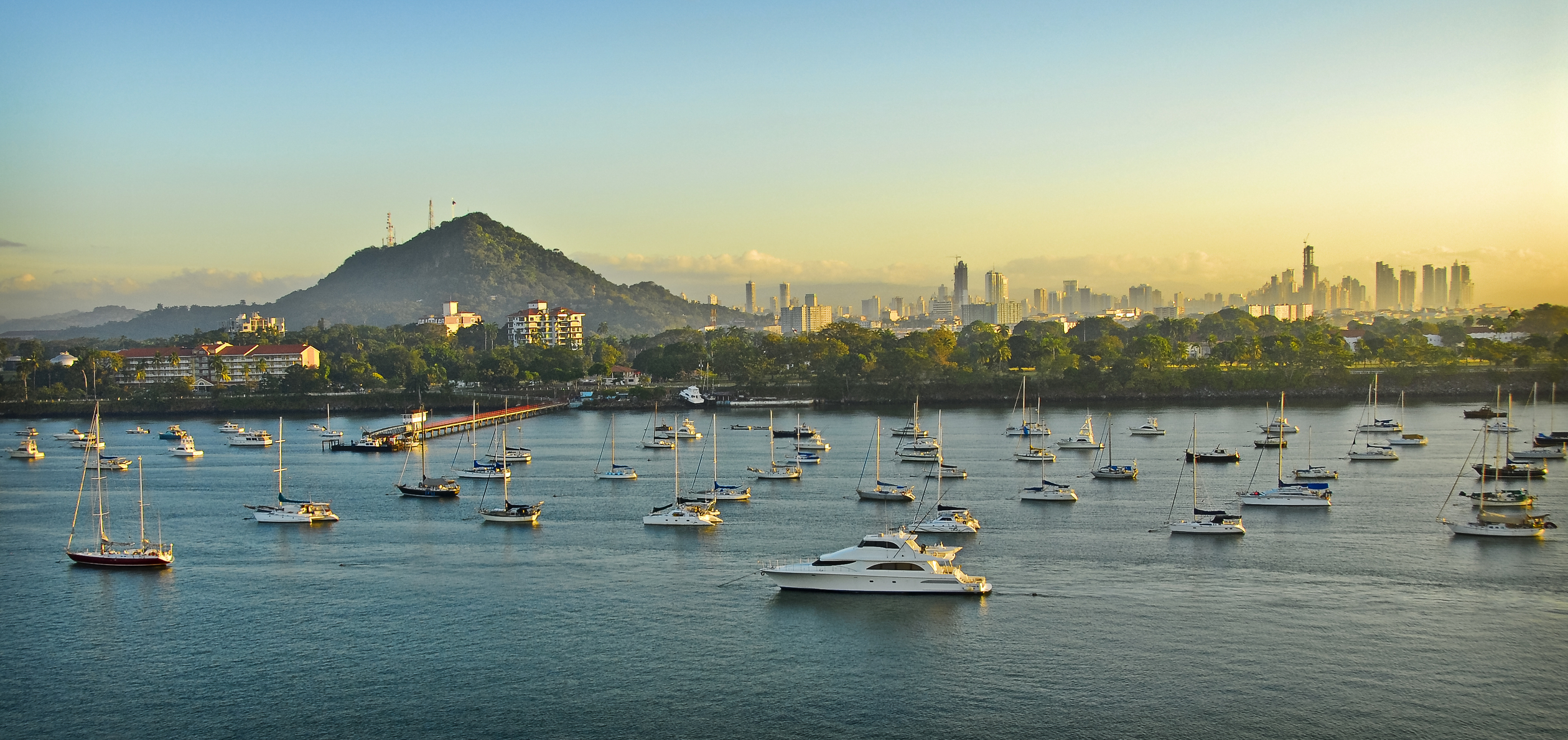
 Panama is the farthest south and the last of the Central American nations, and if you were to take an “S” shape and turn it on its side, that is Panama. Snaking its way from west to east, connecting with mainland South America, and divided only by the colossal ‘Panama Canal’, the country presents an undulating landscape. With a long coast at the Caribbean Sea, and another at the Pacific Ocean, water and beaches play an important part of this country’s appeal. Yet, with some of the most untouched rainforest in the world, lush vegetation and native wildlife provide an attraction in this tropical country.
Due to its strategic location, Panama is popular amongst sailors launching yachting excursions westwards to the Pacific, or linking east with the Caribbean Sea. Yet on land Panama is quite magnificent, with one third of the country reserved as a protected area. From mountainous and volcanic peaks, to dense rainforest, to bright sandy beaches, Panama has it all. Because of the country’s historic location of the famous trans-oceanic shipping canal, Panama City, the nation’s capital, is one of the most developed cities in the region, centered on trade and commerce. You will find glitz and glamour in the city, but the beauty of the unspoiled nature away from the capital in Panama provides a welcome contrast.
The interior of Panama is known to be home to some of the country’s friendliest people, and they are very welcoming of the expanding tourism sector in their area. You will find value-for-money accommodation here whilst roaming the villages viewing genuine handicraft products, such as the famous ‘Panama Hat’. Panama City provides a range of western standard hotels, varying in price. At beachside locations you will find a good choice of comfortable resort-style accommodations, or you can opt to stay in a more traditional historic colonial town location, which all offer modern day conveniences.
You may not want to spend time seeing all of the fifty mile long Panama Canal, but to gain a sense of the importance of this strategic waterway that has shaped economics of the twentieth century you can take a peek at Miraflores Locks, and watch the ships go by. There is a visitor center there with easy access from Panama City. If heading west from the capital, a trip to the Gulf of Chiriqui marine park, which is a well-known spot for whale watching in the Pacific Ocean is worthwhile. Also in the gulf is the ‘Coiba’ marine park, often referred to as the ‘Galapagos Islands’ of Central America, due to its abundant biological diversity and marine life, with wonderful diving and snorkeling potential. If heading east you can visit some of the ‘Darien’ rainforest, one of the densest primeval rainforests in Latin America, providing a natural time held barrier with the continent to the south, although any excursion here would be mainly for an experienced trailblazer due to its pristine nature.
As a tropical country, Panama has two distinct seasons: the wet season, and the dry season. The rainy season lasts between May and November, although the northern Caribbean side of Panama experiences showers all year round. The drier months here are February to March, and September to October. Between mid-December and mid-April is the dry season, although it still may rain during this time, from the occasional shower to a downpour lasting several days. But also, during the rainy season there is also bound to be a high prevalence of sunshine between the rains.
The main gateway into Panama is via Tocumen International Airport (PTY) at Panama City, which receives flights from many US cities such as Houston, Orlando, Miami, and Newark; as well as other European destinations and many cities in Latin America. Interestingly, it is possible to reach Panama via boat, as there are many private charters docking here on their way to and from the Pacific Ocean or the Caribbean Sea. Once in Panama, the road network in the country is well developed so independent exploration using a rental car is a possibility. Otherwise there are plenty of taxis available in the city, or for longer journeys there is a substantial bus network.
Highlights
- Get your hands on a genuine handcrafted “Panama Hat” from traditional makers
- Discover the underwater world in the “Galapagos of Central America” at Coiba marine park
- Live the thrill of whitewater rafting with rapids on the Chagres river
- Hike the Quetzal Trail for great birding opportunities
- Go ocean kayaking around the islands in the Gulf of Chiquiri
- Visit the colonial towns in the second largest inhabited volcanic caldera in the world
- Touch both the Caribbean Sea and Pacific Ocean in a single day, with only 50 miles separating them in Panama, and have a day at the beach at either end
- Marvel at the passing ships and discover the heritage of the world famous Panama Canal